The Git-ification of the World
AI has fundamentally changed how software is created. It will do the same in other industries, but the question is: why software first, and what industry is next?
Venture capitalists claim to invest in technology startups. In practice, that has mostly meant software startups, which today we call AI startups. What I like about being an early career venture capitalist is that the job can be surprisingly academic. A large part of the work is pattern matching: studying past success of individuals, companies, and markets, looking for signals for future success. Software went first because of Git, and the industries that undergo Git-ification soonest will follow.
The difference between AI for software and AI for everything else is stark. In a caricature of myself and every other VC in the world, I started using Claude Code recently. In doing so, the power of a constrained AI system in the world of software became clear. AI coding abstracts yet another layer of technology[1], going from verbal dictation to functional tools, prototypes, products, and businesses.[2]
A huge portion of the world has not begun to touch AI. It’s hard to gauge exactly how much of the world has interacted with it, but directionally, this chart rings true.
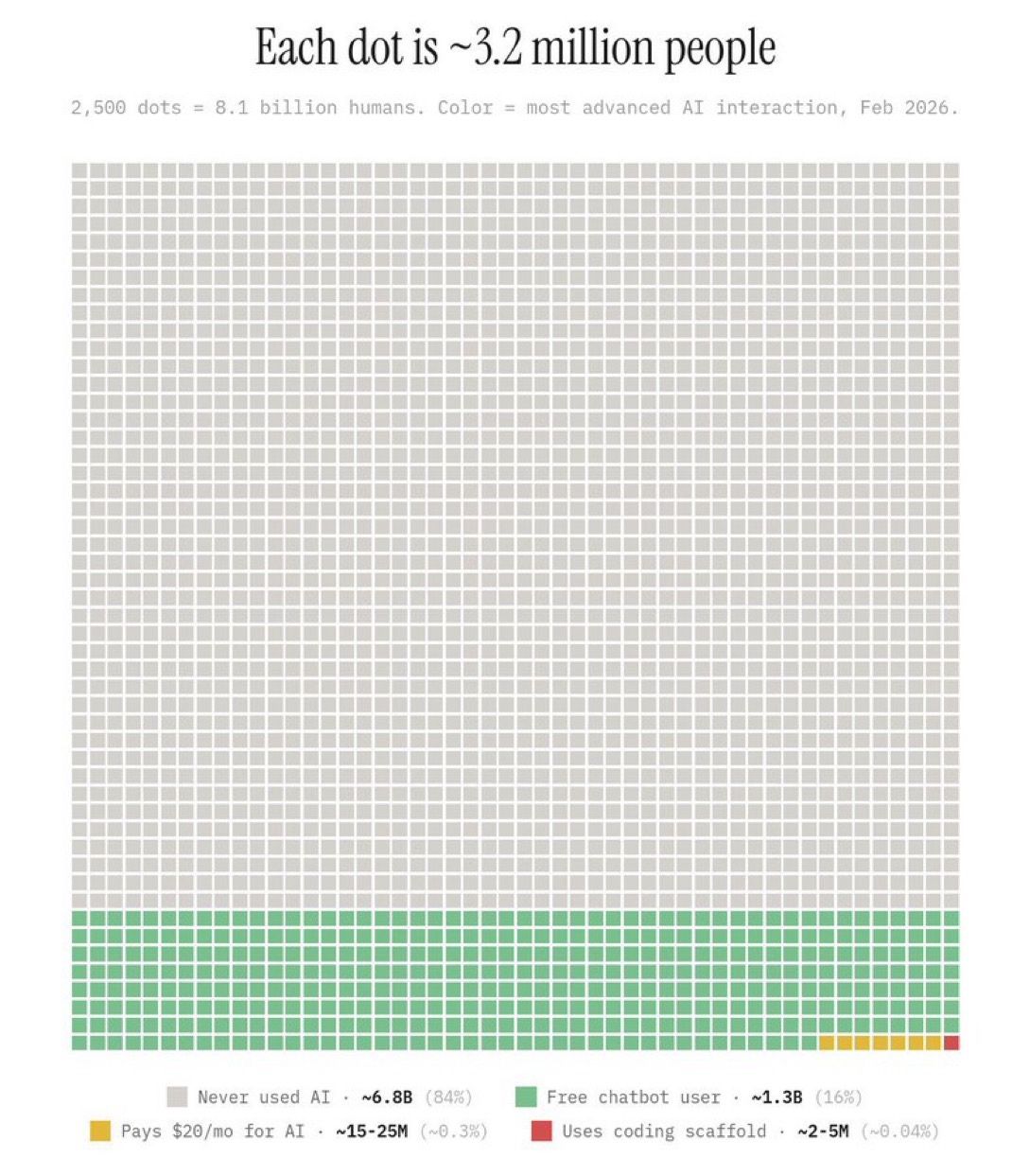
For the small subset of the world living in technology and venture capital, this lack of adoption is incomprehensible. AI is magical. AGI and superintelligence are already here. But for many outside this world, whether they’ve interacted with the black chatbox or not, AI feels like a fancy Google search that gets funny things wrong sometimes.

AI is both underrated and overrated. Your perspective makes all the difference. Of course, that depends on how we define intelligence in the first place.
“The test of a first-rate intelligence is the ability to hold two opposed ideas in the mind at the same time, and still retain the ability to function.” — F. Scott Fitzgerald, “The Crack-Up,” 1936
What we call AI today is mostly thanks to large language models, which may or may not just be fancy autocomplete, enabled by transformers[3]. Regardless, AI works well for creating software. Code is a language, so large language models are a natural fit. The success of AI at coding tasks is not because of the sheer quantity of code as training data. After all, the internet is enormous too and should hypothetically be full of human thought, distilled and written down, which are reflections of intelligence[4].
Code has aspects that the internet misses dearly: inherently forced structure. Coding turns unstructured thoughts into structured thoughts. Codification is what makes line-by-line writing (or coding) so challenging. Writing is thinking. Structuring information is work. It moves from disorder to order, pushing against the natural flows of entropy. I take it one step further. It’s not even that these structured thoughts called code exist. It’s the structure of the structure: Git.
Structure of Git
1. Context. Codebases have incredibly rich context: the why behind how decisions happen. PRs, conversations, issues, comments capture why a change was made and why one approach was abandoned for another. The multi-turn reasoning behind every decision makes for rich training data. Not black-box guess and check. Not just hot dog or not hot dog, but why it’s a hot dog.
2. History. Git provides a perfect, immutable history of the world of software. Every branch, every commit, every version of the context described above is preserved and accessible at fine granularity.
3. Social. GitHub is a social network in its own right, and that engagement compounds the data. The value of software isn’t the code; it’s the human decisions flowing through it.[5]
4. Consequential. The documentation is load-bearing. Code works or it doesn’t. A bad Wikipedia edit devalues an article, but Wikipedia still works. A bad commit can bring the whole system down. That forces a level of quality in the data that almost nothing else on the internet can match.
5. System of work, not record of work. Git is how the work gets done in the first place. Every change flows through Git, and nothing bypasses the system. The record of work is a co-product. Git is the athlete, not the scorekeeper. It’s not a TPS report filed after the fact.
The world started talking about AI in 2022 when ChatGPT launched. This AI was trained on the open internet. It could do a lot of cool party tricks, but it was terrible at actually doing work. Yet the same technology, trained on data rooted in Git, is a functional, useful tool. The underlying technology is the same. The structured data made the difference.
These five pillars of Git offer a framework to understand where AI will next not just promise massive impact, but have massive impact. Where value gets captured in the wake of this impact is still an open question. Git created the structure. GitHub built the platform. Coding agents are the latest layer. Outside of software, the reasoning and context behind decisions almost never get documented. When they do, it’s a chore, a burden to the worker. Obligatorily labeling large amounts of data as an exercise, rather than as part of the process, will never get us where we need to be.
The AI application comes after the data infrastructure, not before. The success of AI in software may have been a happy accident. The next companies to apply AI in other fields have the fortune of not doing it accidentally. They can borrow inspiration from one industry to move the rest of the world forward.
The Git-ification of the rest of the world.
[1] COBOL promised this same abstraction decades ago.
[2] This document is being verbally dictated inside Claude Code, with highly prescribed agents helping to write in the style I’ve defined. They are the secretary and editor, not the content producer.
[3] Transformers run on matrix multiplication (MATLAB fumbled that), which GPUs just happen to be good at.
[5] Attention is all that matters, after all.